
Are All Civilizations Equal?
The "rupture" at Davos

Canadian Prime Minister Mark Carney became the star of the World Economic Forum’s meeting in Davos last month, when he talked about “the rupture in the world order.”
It seems that every day we are reminded that we live in an era of great power rivalry. That the rules-based order is fading. That the strong do what they can, and the weak must suffer what they must.
His main target was the United States, which has used trade tariffs and political and military power to upset the world order established since World War II.
Yet Singaporean diplomat Kishore Mahbubani, who has served as president of the U.N. Security Council, saw another rupture occurring. It is not only that the world order has changed; the lingering Western hegemony in global discourse also needs to be recalibrated in international relations, given the rise of China and India over the past decades.
In an interview, he said,
The 200 years of Western domination of world history had been an aberration because from the year one to the year 1820, the two largest economies in the world were those of China and India. He continued, Western domination has come to an end and is ending very fast.
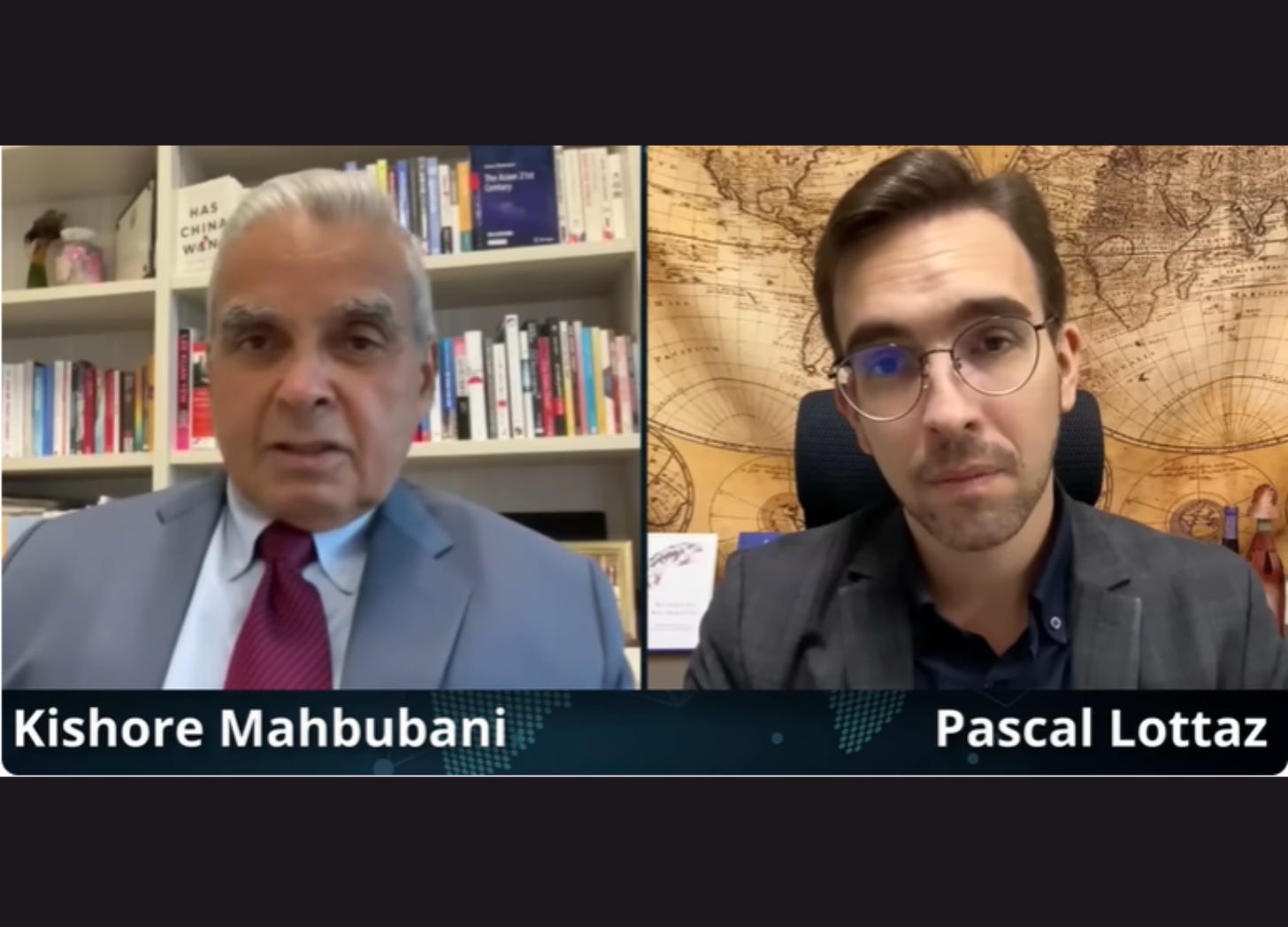
He bolstered his claim with statistics. In 2000, the combined economy of the European Union was eight times that of China. Today, they are about the same size. By 2050, Europe’s economy will be half the size of China’s. But Europe has not adjusted to this new picture and is still making condescending comments about China. Comparing the UK and India, India’s economy has surpassed the UK’s and will be significantly larger by mid-century.
He further said, Europe represents the past, the United States represents the present, and Asia represents the future, where all the growth is coming from.
In a recent article, “All Civilizations Are Equal,” published in the Fletcher Forum of World Affairs, Mahbubani argues that the Western sense of civilizational superiority is no longer justified in a multipolar world, and treating all civilizations as equals is both necessary and pragmatic for global cooperation and stability.
Mahbubani challenges Samuel P. Huntington’s theory of the clash of civilizations. Huntington argues that after the Cold War, future wars and conflicts will not be fought over different ideologies but over civilizations. He maintains that future faultlines will lie between Western and the Sinic and Islamic civilizations. After September 11, many believed that Huntington had predicted the threat of Islamic terrorism to the Western world.
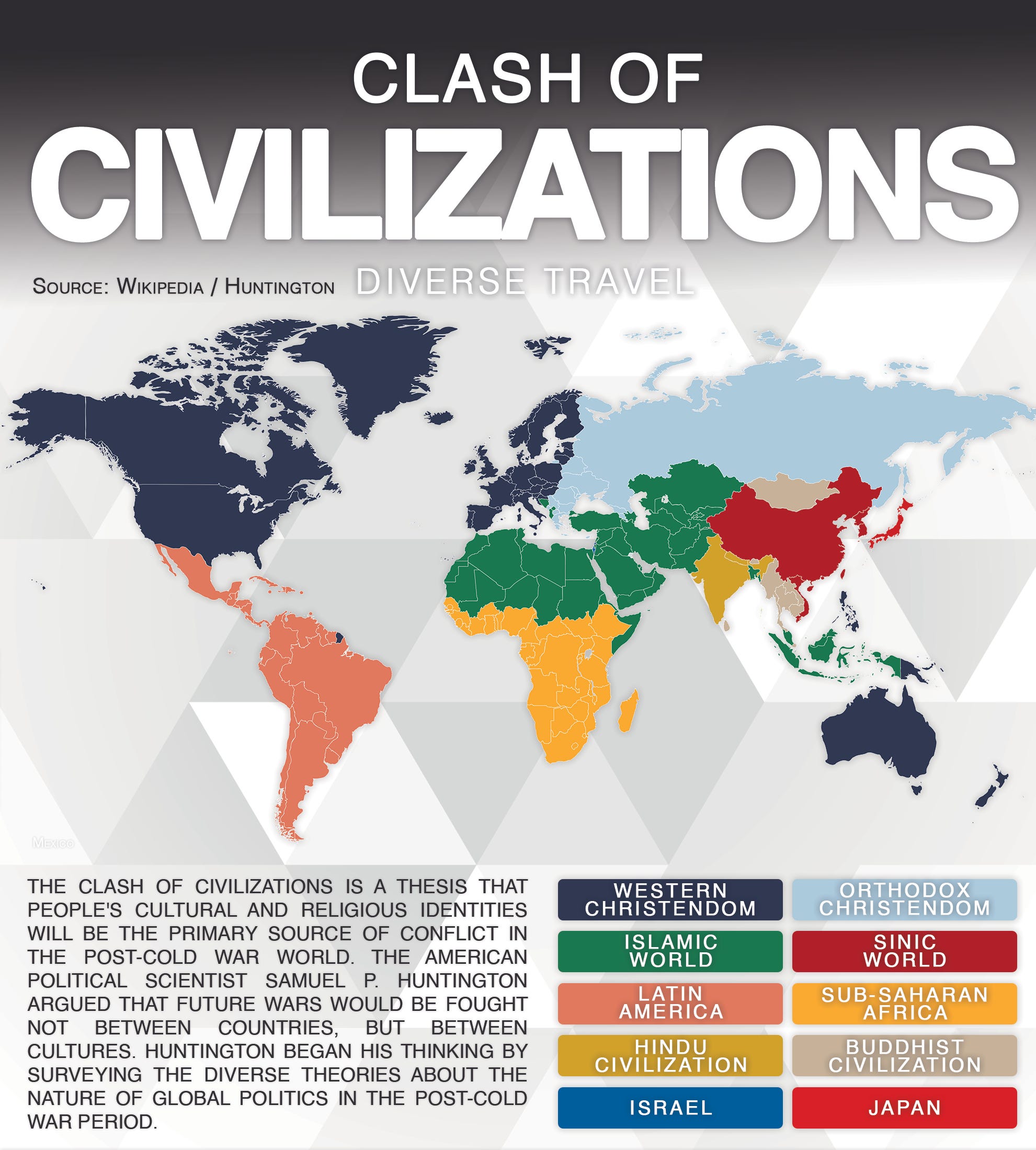
But others have pointed out that Huntington has treated cultures and civilizations as monolithic and bound. For example, the so-called Sinic civilization is highly diverse and pluralistic. Over the centuries, civilizations have borrowed from one another, and no single civilization remains “pure” in the modern world. The clash of civilizations theory is merely another way of putting the West at the center and viewing non-Western cultures as threats.
Besides Huntington’s civilizational theory, Francis Fukuyama argues for the end of history during the latter days of the Bush administration. With the end of the Cold War and the dissolution of the former Soviet Union, Fukuyama contends that human history has reached its zenith in Western liberal democracy. He says, humanity has reached
not just ... the passing of a particular period of post-war history, but the end of history as such: That is, the end-point of mankind’s ideological evolution and the universalization of Western liberal democracy as the final form of human government.
Fukuyama’s confidence was challenged by the rise of China and other Asian countries. Even though China has enjoyed phenomenal economic growth, there is no sign that it has embraced liberal democracy. Fukuyama was challenged during his visit to China and modified his views.
Contrary to Huntington and Fukuyama, Mahbubani is not Western-centered and proposes a realistic, pragmatic way to view changing geopolitics. He is a keen observer of Asian history and politics, having authored books such as Has China Won: The Chinese Challenge to American Primacy, which has been translated into different languages. His books also include Living the Asian Century and The Great Convergence: Asia, the West, and the Logic of One World.
His message is directed at Western elites, who continue to harbor a sense of Western moral superiority, even as its material dominance has diminished. For example, Prime Minister Carney spoke of “our values” – human rights, sustainable development, solidarity, sovereignty, and territorial integrity – as if these values can’t be found in other cultures.
Mahbubani is not naïve to think that civilizations are “equal” in the sense that they are identical in values or practices. What he insists is that no civilization has the right to define international norms. There was a time when modernization meant Westernization. But today, in a pluralistic, multipolar world, we need to move beyond the colonial mindset of “the West and the Rest” and treat other cultures with respect.
Mahbubani’s critique of cultural hierarchy and Western dominance is highly relevant as the U.S. retreats from international organizations and China increasingly asserts its influence and power. Since the beginning of the year, leaders from Korea, Canada, Finland, Ireland, and the UK have visited Beijing to strengthen diplomatic and trade relations. German Chancellor Friedrich Merz is expected to visit China for the first time in late February, and President Trump will visit in April.
While Mahbubani’s proposal for dialogue, respect, and equity is welcome, it must guard against nations seeking to replace the West as the new hegemon. China has touted its model of “socialism with Chinese characteristics” as one for developing countries to emulate. It has challenged the meaning of democracy and the universal value of human rights.
“All Civilizations Are Equal” is a warning against power and arrogance. This warning equally applies to the West, China, and other rising nations. It is an invitation to reimagine world politics as economic gravity and political influences shift to the South and East, and to base international cooperation on mutual recognition and respect.
The pandemic has shown us that we are one world indeed. We all can learn from other civilizations, from other religions, music, the arts and skills, from ancient traditions and from modern ones. Our consciousness has evolved but not yet integrated mind and heart . Otherwise we would appreciate solidarity, community, mutual respect, non-violence and love, and thereby create peace for ourselves and the world.
This is very informative, Pui Lan. I think you are absolutely correct.