
Interimperial Rivalry between China and the U.S.
Trump's visit to China

So Trump can behave like a “normal” person, as we saw in China, said a Taiwanese commentator. China gave the pageantry Trump wanted. Trump reciprocated by showing civility and restraint. He even said in his remarks that he and his delegation of America’s corporate executives came to pay respects to China.
Trump clapped for the Chinese children waving American flags to welcome him and showed no sign of dismay when President Xi Jinping did not personally greet him at the airport, but sent Vice President Han Zheng. He listened and did not lash back when Xi lectured him on not crossing the red line on Taiwan.
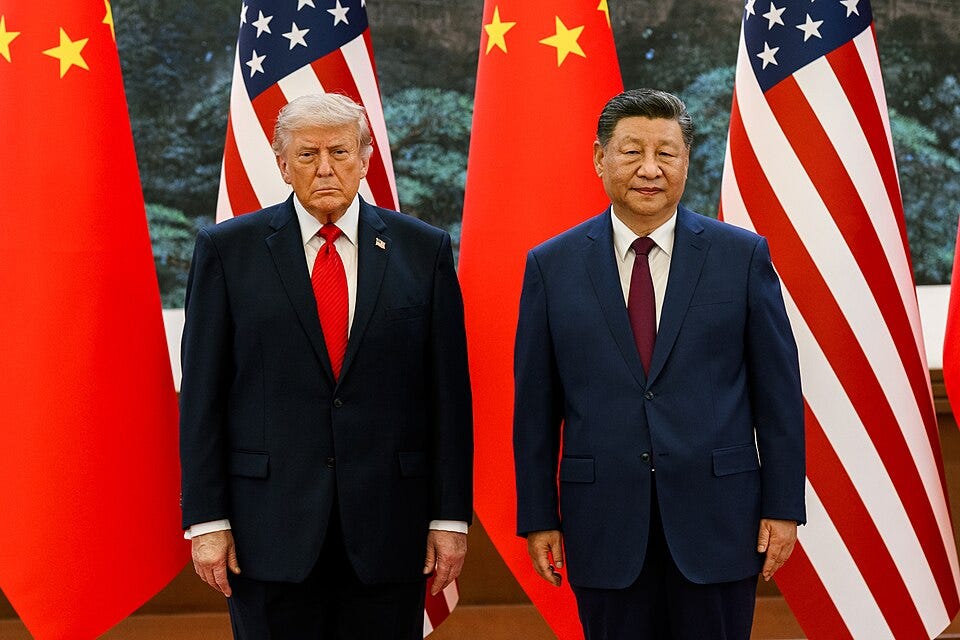
Between Trump’s 2017 visit to China and last week’s visit, Sino-American relations have changed due to shifts in geopolitics. In 2017, China was not a formidable competitor as it is today. After Trump’s first visit, he was hawkish on China. He did not visit China again, and, as president, Joe Biden did not visit China either.
But time has changed. In Beijing, Trump asked China to buy more farm products, energy, and Boeing airplanes. He also wanted China to help press Iran to come to a deal to end the war. China is the largest buyer of Iranian oil.
On the Chinese side, Trump’s visit helped elevate Xi to the status of an equal partner in global politics. China had found a way to develop its AI industry despite the U.S.’s export bans on high-end Nvidia chips. China wanted to talk about Taiwan, which it regards as its territory and the leftover of the civil war after World War II.
Though the U.S. media has always cast China as the archenemy, the relationship between these G2 countries is more complicated as the U.S.’s unipolar hegemony has been replaced with a new asymmetric multipolar world order. In the book China in Global Capitalism, Eli Friedman and the coauthors describe the four stages leading to the breakdown of the world order created after World War II:
The neoliberal boom from the early 1980s to 2008 restructured the world economy and provided new centers of capital accumulation, most importantly China.
China took advantage of the U.S.’s two decades of preoccupation in Iraq and Afghanistan to assert its economic, political, and military influence in many corners of the world.
The Great Recession of 2008 hammered the U.S. and European economies, while China used a massive economic stimulus package to sustain growth and propped up numerous countries’ economies, from Australia to Brazil.
The pandemic and global recession triggered intensified interimperial rivalry, as stimulus plans and cheap money policies did not generate a new boom but stagnation and rampant inflation. Both the U.S. and China adopted nationalist strategies to protect their economies and control discontented populations (pp. 106–7).
As a result of the rivalry, globalization has been restructured, with the system fragmenting into rival national security blocs. On the one hand, there are strategic alliances between the U.S., Japan, South Korea, Taiwan, the Philippines, and Australia. On the other hand, there are deepened connections among China, Russia, North Korea, Pakistan, and Iran, for example. The authors say,
This rivalry between the two states could lead to a much deeper “blocification” of the world economy, with one centered on the US and the other on China.
The competition caused increased geopolitical conflicts over spheres of influence: the U.S. in the Western Hemisphere, Russia in Europe, and China in Asia. The Trump administration’s National Security Strategy, issued in December 2025, emphasized international alliances and partnerships, military readiness and modernization, intelligence sharing, and strengthening cybersecurity measures.
The rivalry triggered a competition for military hegemony in the Asia-Pacific. Last month, the U.S. and the Philippines conducted counter-landing drills with 17,000 personnel from seven countries. Taiwan remained a dangerous flashpoint, as the U.S. saw it as a means to push back against China.
Trump said nothing in public in Beijing about Taiwan. After his two-day visit, he said that the U.S. was “not looking to have somebody go independent.” He also said that Taiwan is so far away and that China has a geographical and military advantage. He told Fox News,
When you look at the odds, China is a very, very powerful, big country. That’s a very small island. Think of it; it’s 59 miles away. We’re 9,500 miles away. It is a little bit of a difficult problem.”
Taiwan’s president, Lai Ching-te , responded that Taiwan will not be traded or sacrificed and will not give up its free way of life, adding that U.S. arms sales to the island are a security commitment grounded in law and crucial to regional security. Trump has not decided to move forward with the arms sales package to Taiwan worth about $14 billion, while Beijing has consistently opposed such arms sales.
Even though China and the U.S. have tense relations, the two countries remain economically intertwined. Decoupling is not so easy, even after Trump has declared a tariff war against China. The competition over AI, high-tech, military power, cyberspace, and outer space will continue.
How can we counter interimperial rivalry? The authors propose internationalism from below—building solidarity across borders between workers and oppressed peoples. More and more Americans are fed up with the Trump administration and the ruling class. The “No Kings” protests drew millions. Such political energies must be channeled into creative, transformative political power.
It is important to examine the role of religion in the interimperial rivalry. Last week, Trump and Xi visited the Temple of Heaven. According to Mircea Eliade, the Temple of Heaven symbolizes the center of the nation, or the center of 天下 (everything under heaven). The Chinese emperors of the Ming and Qing dynasties visited the Temple of Heaven for annual ceremonies to pray to Heaven for a good harvest on behalf of the people. The emperor was called the Son of Heaven, and he ruled according to the Mandate of Heaven.
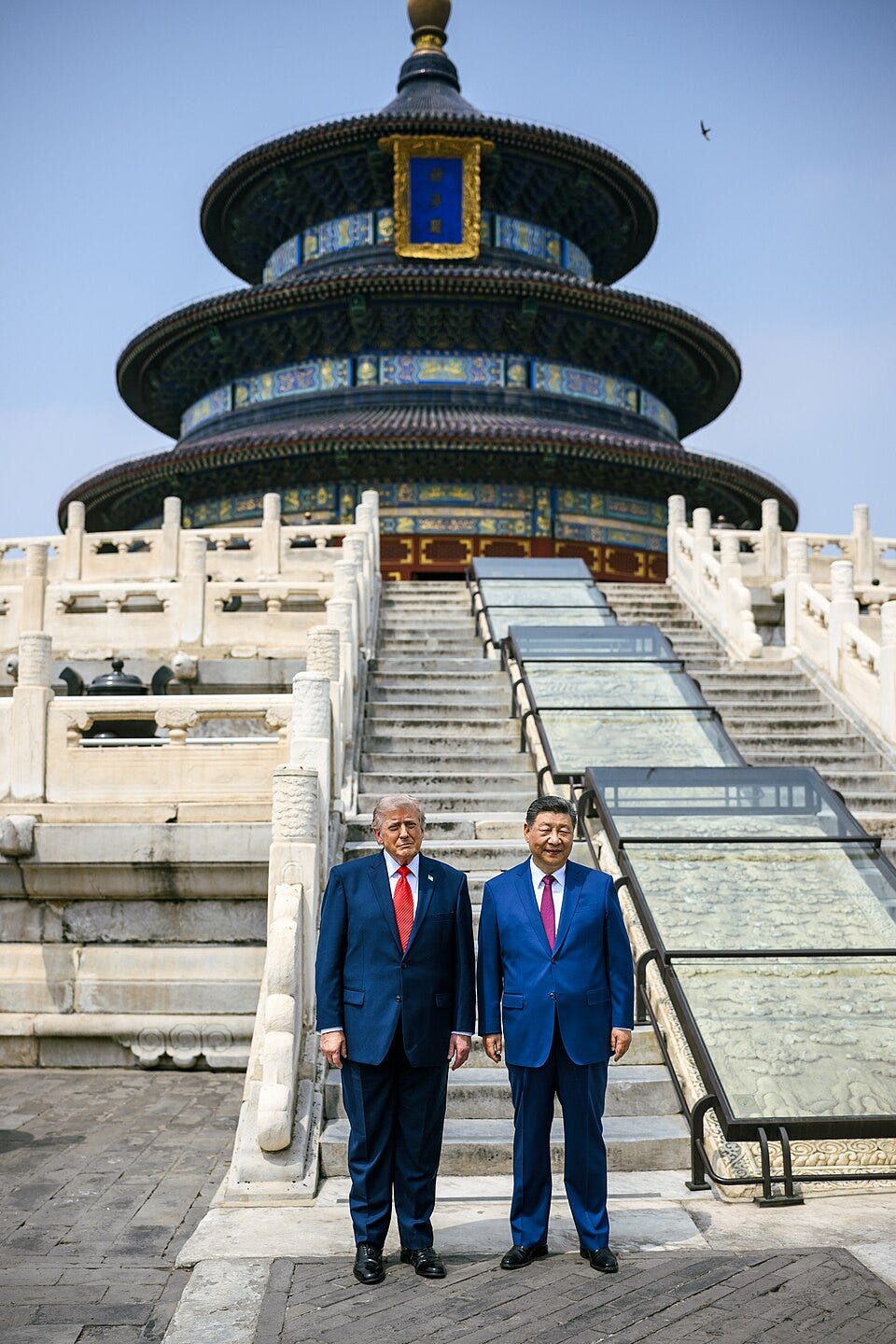
The Communist government has promoted the Sinicization of religion. Xi has called for “doctrines, rules, management systems, rituals and customs, norms of behavior” to embody “Chinese characteristics” and adapt “to the needs of the times.” He recommended “strict enforcement” of regulations and the strengthening of policy directives. He also said that the Sinicization of religion can foster gentleness (和順), ethnic harmony, social harmony, and long-term national stability.
In the U.S., religious fervor has been stirred up to support the MAGA movement, especially among white evangelicals, a key group among Trump’s supporters. On May 17, an all-day prayer festival, Rededicate 250, took place on the National Mall in Washington, D.C., to prepare for the country’s 250th birthday. Mike Johnson spoke at the event alongside other Christian leaders. Donald Trump, JD Vance, Marco Rubio, and Pete Hegseth sent video messages. The event was meant to renew one’s commitment to faith and rededicate the U.S. as one nation under God.
Different gods, different empires, same ancient playbook: the use of religion for state power. Religion has played an important role in the East and the West. How can we harness the power of religion in the international solidarity against interimperial power rivalry? Mary E. Hunt and I discussed some of these issues in this episode of Faithful Provocations.